
You matched, or met, and now you are texting constantly. There are no labels, no real plans half the time, just a steady stream of messages, liked stories, and the occasional date, plus a low hum of “so what is this, exactly?” Welcome to the talking stage, modern dating’s most confusing phase. It is supposed to be the fun, low-pressure beginning. The trouble is that nobody tells you where it ends, or what it means when it never does. Here is the honest version.
The talking stage is the early phase of getting to know someone romantically, before any label or commitment exists. It is mostly texting, flirting, and a few dates while both people test whether there is a real connection. It sits between casually getting to know someone and actually dating. Crucially, it is meant to be temporary: a talking stage that never moves forward has usually become a situationship or a sign you are being strung along.
Table of Contents
What the Talking Stage Actually Is
The talking stage is the romantic-leaning getting-to-know-you period that comes before a relationship is official. You are texting a lot, maybe calling or video chatting, possibly going on early dates, and feeling out whether you actually like each other. There is no label yet, and that is normal at this point. Researchers who studied it found it is genuinely its own thing: not the same as just getting to know a friend, not quite casual dating, and defined mostly by the fact that there is real potential for something more, which both people are quietly testing.
One honest note up front: the name is a bit of a lie. Very little of the talking stage is actual talking. It is mostly texting, sending reels, and reacting to each other’s stories, with real conversation rationed out in between. That matters, because it is easy to feel deeply involved with someone you have barely spent real time with.
Where the Talking Stage Sits (vs Situationship, Dating, and More)
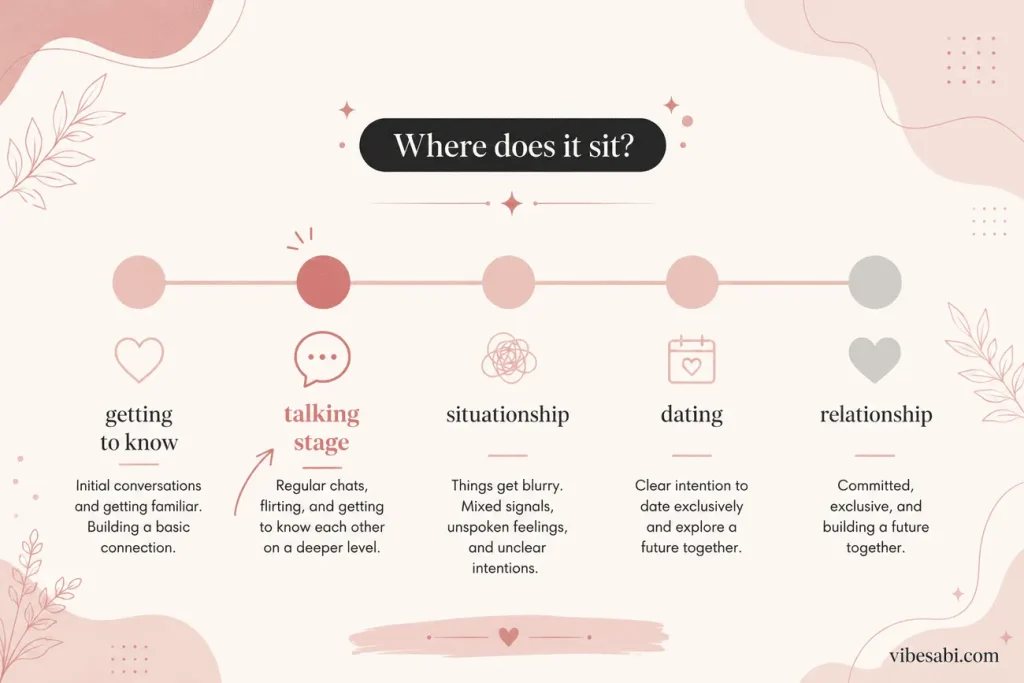
The fastest way to understand the talking stage is to see it as one step on a path. Here is roughly where it falls and how it differs from the stages around it.
| Stage | What it is | Defined? |
| Getting to know someone | Early, friendly, curious contact, no romantic frame locked in yet | No, and not romantic yet |
| Talking stage | Romantic-leaning texting, flirting, and early dates, testing a connection | No, but romance is the point |
| Situationship | Acts like dating, ongoing, still no label: a talking stage that stalled | No, and stuck there |
| Dating | Going on real dates with intent, moving toward exclusivity and a label | Becoming defined |
| Relationship | Exclusive, labelled, committed | Yes |
The key thing this shows: a healthy talking stage moves. It is a doorway, not a room. When it keeps going for months with no progression and no label, it has quietly turned into a situationship, which is its own undefined grey area. If you are trying to untangle that, the situationship vs FWB breakdown sorts out which casual setup you are actually in.
How Long Should the Talking Stage Last?
There is no fixed timer, but there is a useful rule of thumb. A few weeks to a couple of months is normal and healthy: long enough to know if you click, short enough that it is clearly heading somewhere. Once you pass the two or three month mark with no movement toward dating, no exclusivity conversation, and no real-life consistency, the talking stage has stopped being a phase and started being a holding pattern.
That holding pattern usually means one of three things: you have slid into a situationship, the other person is comfortable keeping you as an option, or one of you is avoiding the conversation. None of those are the end of the world. They are just signals that it is time to find out where you actually stand.
Signs the Talking Stage Is Going Well
- Replies are consistent, and they initiate just as often as you do.
- Conversations go past small talk into real things: your lives, your opinions, your day.
- You are making actual plans to meet up, not just texting endlessly.
- They are slowly folding you into their world, mentioning friends, future plans, inside jokes.
Signs It Is Dying (or Was Never Alive)
- The texting is dry and one-sided, and you are always the one starting it.
- Weeks go by with lots of messaging but no concrete plan to actually see each other.
- Months pass and nothing has changed: the classic perpetual talking stage.
- Any future-tense question, even a small one, gets dodged or left on read.
If most of the second list sounds familiar, that is not a phase warming up slowly. That is information. It may also be worth understanding whether you’re experiencing breadcrumbing rather than a genuine talking stage.
How to Move the Talking Stage Forward
If you like them and you want more than a texting pen-pal, the only real move is to say so. It does not have to be a dramatic showdown. Calm and direct works best:
“I’ve really liked getting to know you. I’m at the point where I’d rather see where this goes for real than keep it casual. Are you on the same page?”
Then read the response honestly, including the dodge. Someone who likes you back will be glad you asked. Someone keeping you as a backup will get vague or remind you that they “aren’t really looking for anything.” Both answers tell you what to do next. You are not being needy by wanting clarity. You are saving yourself weeks of guessing.
Why the Talking Stage Even Exists
It did not used to be a named phase. A few things created it. Dating apps gave everyone endless options, so people hedge instead of committing. Texting made it possible to feel close to someone without ever being in a room together. And there is a genuine dopamine pull to a phone lighting up with attention, which can keep a talking stage running on pure novelty long after it should have either progressed or ended.
None of that makes it bad. At its best, the talking stage is a low-stakes way to find out if you vibe before anyone gets invested. At its worst, it is a comfortable place to park someone you are not sure about, or to delulu yourself into believing a few good texts are a relationship. The difference, as always, is honesty and movement.
Talking Stage FAQs
Q. What is the talking stage in dating?
It is the early, romantic-leaning phase of getting to know someone before any label or commitment, mostly texting, flirting, and a few early dates while both people test whether there is a real connection. It sits between casually getting to know someone and officially dating.
Q. What is the difference between the talking stage and a situationship?
A talking stage is the early, temporary phase that is supposed to lead somewhere. A situationship is what a talking stage becomes when it stalls: an ongoing, undefined connection that acts like dating but never gets a label. In short, a situationship is a talking stage that got stuck.
Q. How long should the talking stage last?
A few weeks to a couple of months is normal and healthy. Once you pass two or three months with no movement toward dating, no exclusivity talk, and no real-life consistency, it has become a holding pattern rather than a phase, and it is worth having a direct conversation.
Q. Is the talking stage the same as dating?
No. In the talking stage there is no label, no agreed exclusivity, and a lot of texting. Dating involves consistent in-person plans with clear intent and movement toward exclusivity. Signs you have crossed over include meeting each other’s friends, more consistency, and talking openly about where things are going.
Q. How do I know if the talking stage is going well?
Good signs are consistent two-way effort, conversations that go past small talk, real plans to meet, and being gradually included in each other’s lives. Warning signs are dry one-sided texting, lots of messaging but no plans, no progression over months, and dodged questions about the future.
Q. How do I move on from the talking stage?
Say what you want, calmly and directly: that you have enjoyed getting to know them and would like to make it something real. Then read the answer honestly. A genuine match welcomes the conversation; someone stalling will get vague. Either way, you get the clarity to decide your next step.

