You text every day. You hang out on weekends. You sleep together. Your friends keep asking what you guys actually are, and you keep saying “I don’t know, it’s complicated.” Congratulations. You might be in a situationship.
The word has become one of the most-used dating terms of the last few years, and for good reason. It describes something millions of people have experienced but never had a name for: a connection that feels romantic but refuses to call itself a relationship.
This article breaks down what a situationship actually is, how to tell if you’re in one, why they happen so often now, and what to do if you want out (or in).
A situationship is a romantic or sexual relationship that lacks clear definition or commitment. It sits between casual dating and an official relationship. The people involved act like a couple in some ways but avoid labels, future plans, or formal commitment. The term became popular in the 2010s and is now widely used in modern dating culture.
Table of Contents
What Does Situationship Mean?
The word “situationship” combines “situation” and “relationship.” The idea is that you’re in a situation with someone, not a real relationship. There’s romance, intimacy, maybe even exclusivity in some cases, but no labels and no clear direction.
Some people end up in situationships by accident. They start dating casually and never have the conversation to make it official. Others are in them on purpose because one or both people don’t want a full relationship right now. Either way, the defining feature is the same: emotional and physical involvement without a clear definition of what you are.
It’s not the same as a hookup. A hookup has no expectations. It’s not the same as casual dating either, where both people know they’re keeping things light. A situationship has the closeness of a real relationship but none of the structure.
Dr. Sarah Hill, an evolutionary psychologist and author of “This Is Your Brain on Birth Control,” has discussed how modern dating environments create attachment ambiguity that didn’t exist in previous generations. Other relationship researchers have linked the rise of situationships to what psychologists call “ambiguous loss,” a state where the relationship neither ends cleanly nor progresses, leaving emotional uncertainty.
Where Did the Term Come From?
The word started showing up online in the early 2010s, mostly on dating blogs and Black Twitter. It went mainstream around 2017 when relationship podcasts and dating app articles started using it. By 2022, Tinder added “situationship” as an official relationship status option in its app, which is when the term truly entered everyday dating vocabulary.
The reason it stuck is simple. People needed a word for something that already existed but had no name. Dating apps changed the rules of romance. Endless options, low commitment, and the ability to talk to multiple people at once created a new in-between zone that the old vocabulary (boyfriend, girlfriend, fling, casual) couldn’t describe. The same cultural shift that popularized situationships also gave us terms like talking stage, which describes the early phase of getting to know someone before dating officially, and delulu, a slang term for unrealistic romantic thinking. These words capture the messy emotional reality of modern dating in a way that older language just couldn’t.
Situationships in Pop Culture
Pop culture was documenting situationships long before anyone had a word for them. Carrie and Mr. Big in Sex and the City are the original on-screen example: six seasons of romantic involvement, emotional intensity, and zero clear commitment. He introduced her to his mother as a “friend.” She kept coming back anyway. No label, no direction, just the cycle repeating itself. More recently, Love Is Blind Season 6 gave the term a new reference point when AD and Clay played out a textbook will-they-won’t-they dynamic in front of millions, with Clay leaving AD at the altar after months of emotional investment and no clear commitment. And He’s Just Not That Into You (2009) was essentially a two-hour film about people stuck in situationships before the word existed. The stories were everywhere. The vocabulary just hadn’t caught up yet.
Signs You’re in a Situationship
You might be in a situationship if you can relate to most of these:
You haven’t had “the talk.” Weeks or months in, and there’s still no conversation about what you are or where this is going. Every time it gets close, one of you changes the subject.
Your plans are always last minute. No one is locking in dates a week ahead. You hang out when it’s convenient, not when it’s planned.
You don’t post each other or talk about each other publicly. You exist in a private bubble. Their friends might not know you exist. Your Instagram stays separate.
You feel uncertain after every interaction. You leave a great date wondering if it meant anything. You read texts five times trying to figure out what they really mean.
There’s no future tense. You talk about today, this weekend, maybe next week. But not next month, not the holidays, not next year.
You’re not sure if you’re exclusive. And you’re afraid to ask, because asking means having the conversation you’ve been avoiding.
Your friends have stopped asking about it. They’ve heard “I don’t know what we are” too many times.
If three or more of these sound familiar, you’re in a situationship.
Situationship vs Relationship vs Friends With Benefits
People often mix these up, so here’s a clear comparison.
| Feature | Situationship | Relationship | Friends With Benefits |
|---|---|---|---|
| Emotional connection | Yes | Yes | Usually no |
| Physical intimacy | Yes | Yes | Yes |
| Clear label | No | Yes | Yes (just casual) |
| Exclusivity | Unclear | Yes | No |
| Future plans | No | Yes | No |
| Public acknowledgment | Rare | Yes | Sometimes |
| Defined expectations | No | Yes | Yes (just sex) |
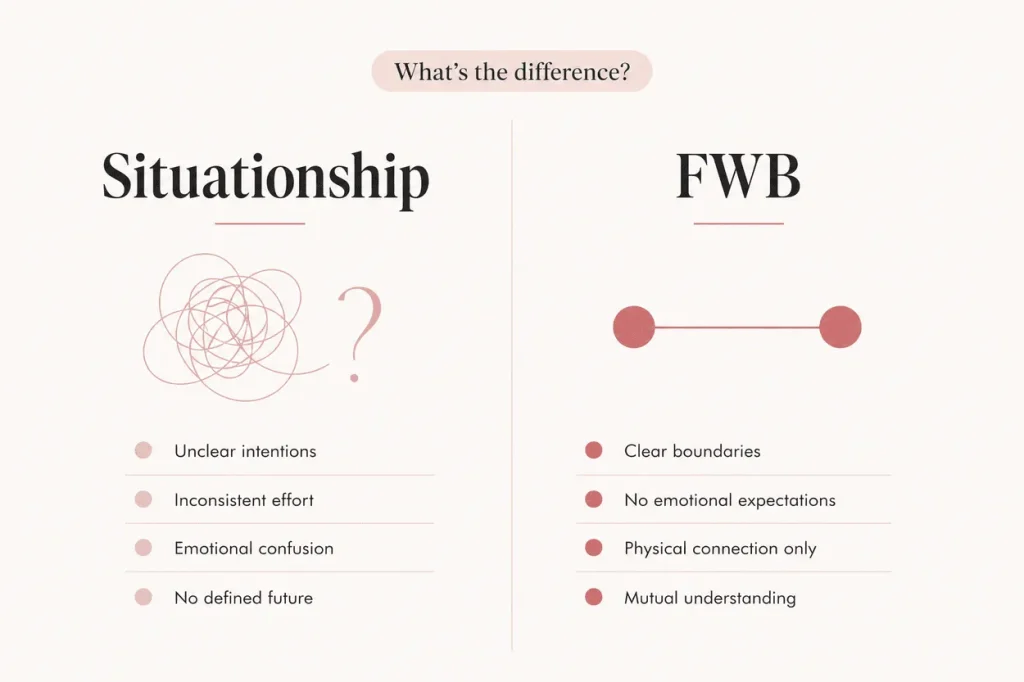
The key thing to notice: a relationship has clear labels and clear expectations. Friends with benefits has clear expectations too (it’s just casual). A situationship has neither. That ambiguity is exactly what makes it confusing.
Why Situationships Happen So Often Now
A few cultural shifts created the perfect environment for situationships to thrive.
Dating apps changed the game. When you can match with hundreds of people in a week, the pressure to commit to one person early disappears. People keep their options open by default.
Commitment feels riskier than it used to. Younger generations grew up watching rising divorce rates, financial instability, and shifting career paths. Locking into a serious relationship feels like a bigger gamble than it did 30 years ago.
Communication is constant but shallow. Texting all day creates the feeling of closeness without the substance of real conversation. You can be in someone’s pocket 24/7 and still not know where you stand.
Fear of vulnerability. Defining a relationship means saying “I want this with you,” which means risking rejection. Staying undefined means never having to take that risk.
Different timelines. One person might be ready for commitment, the other not. Instead of breaking it off, they coast in the in-between zone hoping things will eventually align.
Are Situationships Always Bad?
Not necessarily. Some situationships work for both people, at least for a while.
If both of you genuinely don’t want a full relationship right now (because of school, career moves, healing from a past relationship, or just personal preference), a situationship can be a low-pressure way to enjoy companionship and intimacy. Some situationships even evolve into real relationships over time, once both people are ready.
The problem starts when only one person is okay with the situation. If you secretly want commitment and you’re staying in a situationship hoping the other person will come around, it usually ends in heartbreak. The longer you stay, the more attached you get, and the harder it becomes to walk away.
The honest test is this: would you be okay if this stayed exactly the way it is forever? If yes, you’re fine. If no, you’re hurting yourself.
How to Get Out of a Situationship
If you’ve decided you want out, here’s how to do it without drawing it out for months.
Get clear on what you want first. Don’t have the conversation until you know what you’re asking for. Do you want to make it official? End it completely? Take a break and reassess? Decide before you talk.
Have the conversation in person if you can. A situationship lives in texts and last-minute meetups. Ending it deserves more respect than a text. If meeting in person isn’t possible, a phone call beats a message.
Be direct, not dramatic. Something like: “I’ve been thinking about this, and I want a real relationship. I don’t think we’re on the same page, and I need to step back.” Short, clear, no blame.
Don’t negotiate against yourself. If they say “let’s just keep going and see what happens,” that’s the same conversation you’ve been avoiding for months. Accepting it means staying stuck.
Cut contact for a while afterward. Going from “we talk every day” to “let’s still be friends” rarely works. Take space, even if it feels harsh. You need it.
How to Turn a Situationship Into a Relationship
Sometimes you don’t want out. You want them to commit. Here’s the realistic version of how that goes.
You have to actually have the conversation. There’s no trick, no manifesting, no waiting for the right moment. You bring it up. You say what you want. You listen to their answer.
If they want the same thing, the situationship ends and a real relationship begins. If they don’t, you have your answer, and you can decide what to do with it. There’s no third option where you stay in the situationship and somehow it transforms on its own.
The hardest part is being okay with the answer being “no.” Most people stay in situationships because they’re afraid of that answer. But not knowing is worse than knowing. At least with a real answer, you can move on.
Frequently Asked Questions
Q. How long does a situationship usually last?
Most situationships last between a few weeks and several months. Some drag on for over a year, especially when one person hopes things will eventually become official. The longer they last, the harder they are to end.
Q. Is a situationship cheating if one person is in a relationship?
Yes. If one person is committed to someone else, the situationship is a form of cheating, regardless of how it’s labeled. The lack of a formal title doesn’t change what’s happening.
Q. Can a situationship turn into a real relationship?
Yes, but only if both people actively decide to make that change. It doesn’t happen on its own. Someone has to bring it up and have the conversation.
Q. Why do situationships hurt so much when they end?
Because the emotional investment is real, even if the label isn’t. You spent time, energy, and feelings on someone who never officially committed to you. The ending feels like a breakup but without the closure that a real relationship would have given you.
Q. Are situationships more common than real relationships now?
They’re definitely more common than they used to be, especially among people in their twenties. Dating apps and shifting attitudes toward commitment have made the in-between zone the default for many people.
Q. Should I tell my friends I’m in a situationship?
Yes. Talking about it with people you trust helps you see the situation clearly. Friends can spot patterns you might be ignoring, and saying things out loud often helps you figure out what you actually want.