
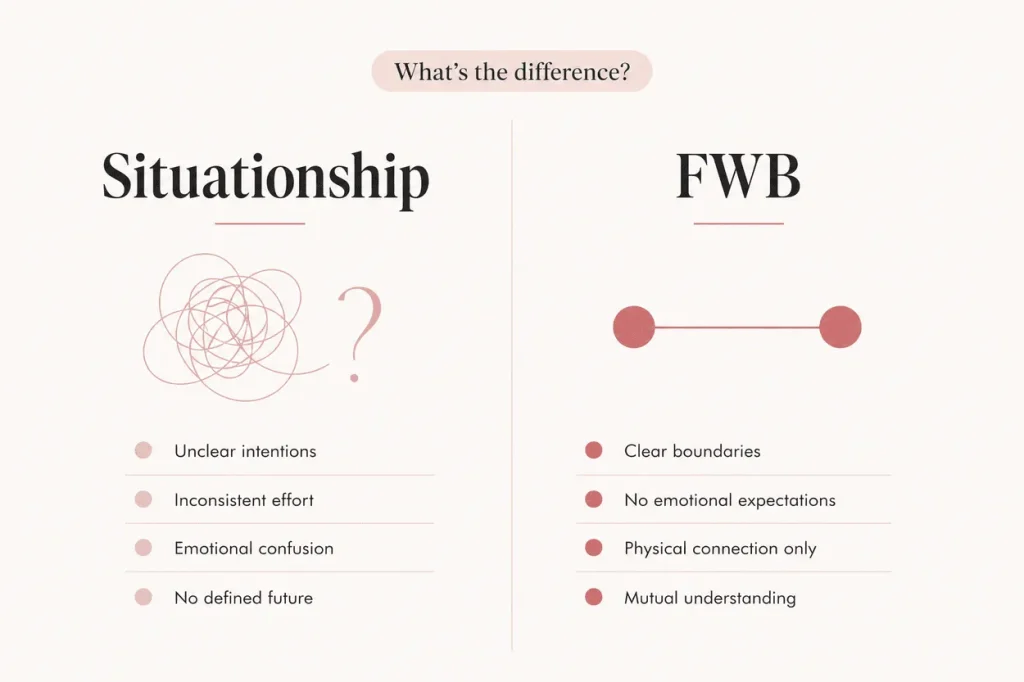
You have been seeing someone, or sleeping with someone, or some blurry combination of the two, and you are not sure what to call it. Is this a situationship? Friends with benefits? Both terms get thrown around like they mean the same thing, and most explainers just list a pile of overlapping traits that leave you exactly as confused as before. Here is the version that actually settles it, with one clear dividing line, a side-by-side table, and a way to figure out which one you are in.
The difference between a situationship and FWB comes down to one thing: definition. Friends with benefits is a defined casual arrangement, where both people understand it is a friendship plus physical intimacy with no romance. A situationship is undefined, a connection that acts like dating but has no agreed label or commitment. FWB has a rulebook both people know. A situationship is the missing rulebook.
Table of Contents
What Is a Situationship?
A situationship is a romantic or sexual connection that lives in the grey area between casual dating and a real relationship. You text, you hang out one-on-one, you might act coupley in public or even sleep over, but nobody has defined what it is. The defining feature is the ambiguity itself. There is usually some emotional investment, often growing, and very often one person quietly wants more while the other keeps things vague. If you want the full breakdown, signs, and how they tend to end, read the complete situationship guide.
What Is Friends With Benefits (FWB)?
Friends with benefits is more straightforward. It is two people who are actually friends and have agreed to add physical intimacy to that friendship, with no romance and no commitment expected. The key word is agreed. In a healthy FWB setup, both people understand and accept the same thing: this is casual, we are not dating, feelings are kept out of it, and either person can walk away or start seeing someone else. The friendship comes first, the benefits are a bonus, and the boundaries are usually clearer than in any other casual setup.
The Real Difference: It Comes Down to Definition
Strip away the overlap and you are left with one clean distinction. FWB is defined. A situationship is not. That single difference explains almost everything else.
In a friends with benefits arrangement, both people have, at some point, understood the terms: we are friends, we hook up, we are not in a relationship. There is a shared agreement, even if it was never written down. In a situationship, that conversation never happened, on purpose. The status is left blurry, which lets it feel like a relationship without anyone having to commit to one. FWB knows what it is. A situationship survives precisely by not knowing.
The other tell is where each one starts. FWB usually begins as a real friendship that adds a physical element. A situationship usually begins as dating behaviour, the texting, the dates, the closeness, that simply never gets a label attached.
Situationship vs FWB: Side by Side
| Situationship | Friends With Benefits | |
| Is it defined? | No, deliberately undefined | Yes, an understood casual arrangement |
| Where it starts | Dating behaviour with no label | An existing friendship plus intimacy |
| Emotional involvement | High and murky, feelings often grow | Lower, kept casual on purpose |
| Dating behaviours | Often yes: dates, texting, meeting friends | Usually not, mostly hanging out and hooking up |
| The vibe in one line | “What are we?” | “We both know what this is” |
| Main risk | Ambiguity and one person wanting more | Feelings creeping in and ending the friendship |
| Where it usually goes | A relationship, or a slow painful fade | Stays casual, or quietly ends |
The Overlap and the Danger Zone
Here is why people mix the two up: they genuinely blur. A friends with benefits situation that catches feelings starts to look like a situationship. A situationship that never gets defined starts to function like FWB. From the outside, both can involve physical intimacy, casual plans, and real fondness.
The danger zone is not casualness. Plenty of people are happy in clearly casual setups. The danger zone is mismatched expectations: one person thinks it is light and physical, the other thinks it is heading somewhere. That gap is where almost all the hurt comes from. The classic version is the person who opens with “I’m not looking for anything serious” and then texts you good morning every day, takes you on dates, and introduces you to their friends. The words say FWB. The behaviour says relationship. The mismatch does the damage.
Which One Are You In?
A quick honest self-check. You are likely in a situationship if:
- You were never actually friends first, the connection started as something romantic-ish.
- You do relationship things (dates, sleepovers, daily texting) but there is no label.
- You feel anxious about where you stand, or you avoid the “what are we” question.
- One of you clearly wants more, and it is not being talked about.
You are likely in a friends with benefits situation if:
- You were genuine friends before anything physical happened.
- You both said out loud, or clearly understood, that this is casual and not dating.
- You mostly hang out and hook up rather than going on dates.
- Neither of you is waiting for it to turn into a relationship.
If you read the FWB list and felt a pang at “neither of you is waiting for it to become a relationship,” that pang is your answer. You might be calling it FWB while living in a situationship.
How to Get Clarity (Without Making It Weird)
The only real fix for ambiguity is a conversation, and it does not have to be the dramatic define-the-relationship showdown people dread. Keep it short, calm, and honest. Something as simple as this works:
“I’m having a really good time with you. I’m not trying to force a label, I just want to know if we’re on the same page about what this is, so I can look after myself either way.”
Then listen to the answer, including the parts they do not say. Someone who wants the same thing as you will meet the question with reassurance. Someone keeping you in the grey area will get vague, change the subject, or remind you they “told you they weren’t looking for anything serious.” Both responses are information. You are not asking them to marry you. You are asking for enough clarity to make your own choice with your eyes open.
Is One Better or Healthier Than the Other?
Neither is bad on its own. A friends with benefits arrangement that is honest and consensual can be completely healthy, and a situationship can be a fine, low-pressure phase if both people are genuinely relaxed about it. Casual is not the problem. The problem is ambiguity plus mismatched expectations, which situationships are simply more prone to because the lack of definition is the whole design. The healthiest version of either one is the same: everyone involved knows what it is and actually wants that. The unhealthiest version is the one where you are quietly hoping it becomes something it was never agreed to be.
And a gentle Vibesabi aside: if you have ever narrated a totally undefined situationship to your friends like the two of you are basically engaged, that is the delulu talking. A little delusion is fun. Mistaking it for a status update is how the grey area keeps you stuck.
Situationship vs FWB FAQs
Is a situationship the same as friends with benefits?
No. Friends with benefits is a defined casual arrangement between two friends who have agreed it is physical and not romantic. A situationship is an undefined connection that acts like dating but has no agreed label or commitment. The core difference is whether it has been defined.
Which is more casual, a situationship or FWB?
Emotionally, FWB is usually the clearer and more genuinely casual of the two, because both people have agreed to keep feelings out of it. A situationship often looks casual but carries more emotional ambiguity and unspoken hope, which makes it feel heavier than it admits to being.
Can a situationship turn into a relationship?
Yes, situationships can become relationships, but usually only when someone actually names what they want and both people agree to commit. Left undefined, a situationship more often fades than it graduates.
Can friends with benefits turn into a relationship?
It happens, but less often, and it tends to be riskier because the setup was built specifically to avoid romance. If feelings grow on one side and not the other, the friendship can take the damage. It works best when both people openly want the shift.
How do I know which one I’m in?
Ask whether you were friends first and whether you both clearly agreed it is casual. If yes to both, it is probably FWB. If the connection started as romantic-ish, has dating behaviour, and was never defined, it is probably a situationship. The self-check above breaks down the signs of each.
Is being in a situationship or FWB bad?
Not inherently. Both can be healthy when they are honest, consensual, and both people genuinely want the same thing. The harm comes from ambiguity and mismatched expectations, not from being casual. The fix is clarity, which usually means one honest conversation.

